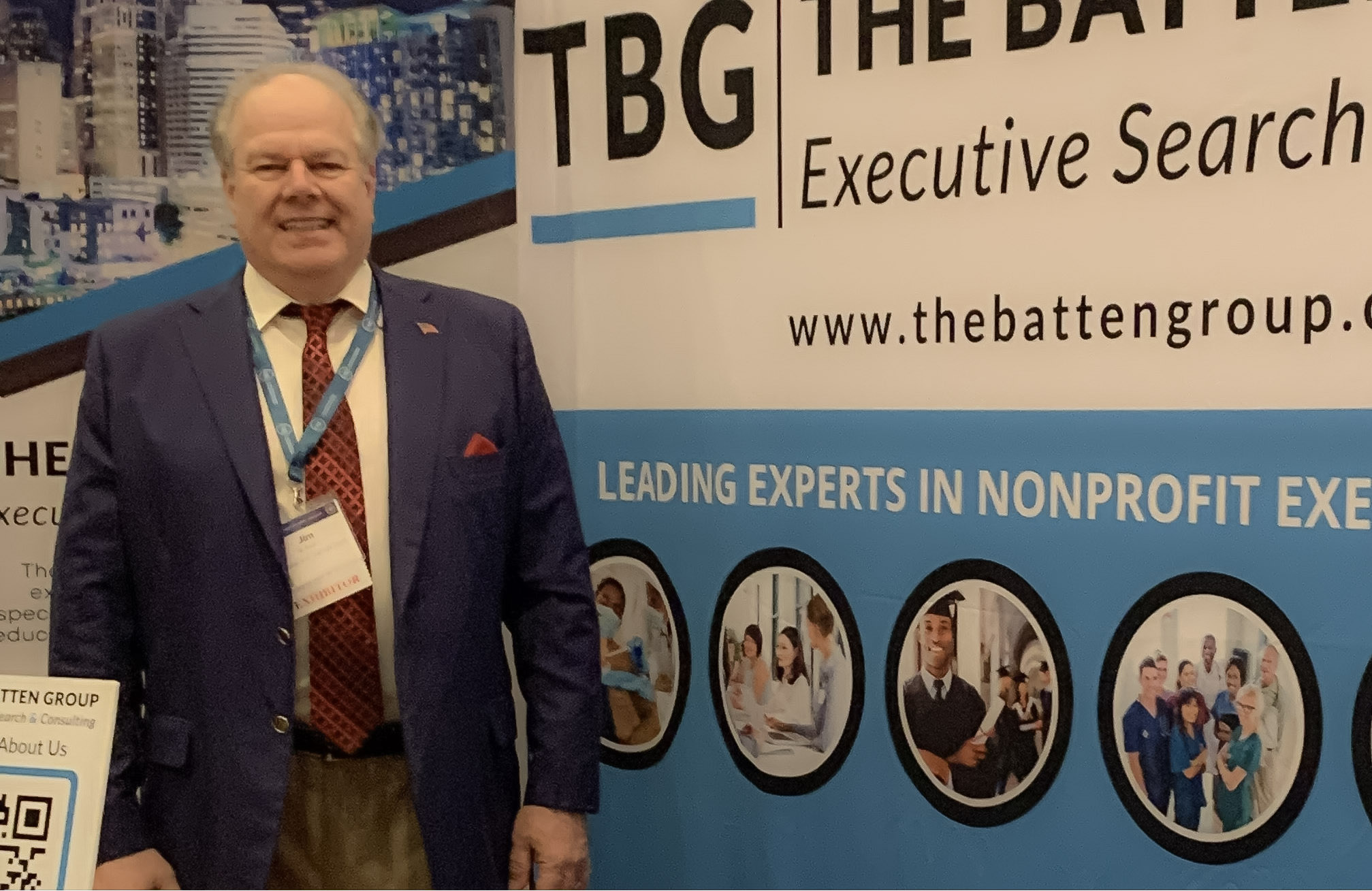
Nonprofit executive hiring trends have shifted significantly in the last 12 to 18 months. And if you want to understand what’s really changing — not the surface-level observations, but the things that are actually affecting searches on the ground — Jim Batten is the right person to ask.
Jim has placed more than 650 leaders in nonprofit, healthcare, and higher education organizations over the past 16 years. He’s seen a hiring freeze during a financial crisis. He’s watched the pandemic flip every assumption organizations had about where and how people work. He’s seen the candidate market swing from “we can’t find anyone” to “we have too many options” and back again.
So when I sat down with him recently, I wanted to know: after all of that, what’s actually different right now?
His answers surprised me.
“You can’t screen for vision with a multiple-choice question.”
The first thing Jim brought up wasn’t the economy, remote work, or even the funding climate.
It was AI.
Specifically, the growing trend of organizations using AI bots as the first point of contact with candidates, before a human being ever enters the conversation.
“Some organizations are using an AI bot as the first screening of an applicant,” he told me. “As opposed to having a conversation to understand their EQ, their passion, their vision, their motivation.”
He gets the efficiency argument. But he’s concerned about what gets lost.
The traits that actually make a great leader — emotional intelligence, genuine passion for a mission, the energy someone brings to their vision — those don’t show up in a bot screening. They surface in conversation.
And right now, more organizations than ever are skipping that conversation entirely.
Nonprofit Executive Hiring Trends: What Candidates Are Really Thinking
When I asked Jim to compare a search he ran in 2009 or 2010 to one he’s running today, his answer wasn’t about the organizations. It was about the candidates.
“Candidates have seen that organizations are quicker to shift today regarding their needs and plans,” he said. “More pivoting. Less consistency.”
And candidates have felt the ripple effects of that firsthand.
So before they commit to anything, they’re digging deeper. They want to understand the culture. They want to know why the position is open. They want to know what winning looks like in 90 days and in three years.
They’re also asking a harder question that Jim says didn’t used to come up this early or this directly:
Is this organization actually loyal to its people?
That question tells you something about what the candidate market has experienced.
“Protecting the status quo is not the same as protecting the organization.”
This is the part of our conversation that stuck with me most.
I asked Jim what mistakes he sees organizations making right now that he didn’t see — or didn’t see as often — five years ago.
His answer was direct.
More and more, organizations are choosing to promote from within, not because the internal candidate is the strongest option, but because it’s easier. Safer. Less expensive.
“Recruiting talent from the outside means they need to pay today’s market price,” Jim said. “And it means risking changing the norm that exists.”
A new leader from outside brings different experiences, different cultures, and different ideas. And for some organizations, that’s exactly what they’re not ready for.
Here’s the problem with that thinking: the best thing that can happen to a stagnant organization is a fresh perspective. Someone who asks “Why do we do it this way?” Not to be difficult, but because they genuinely want to know.
Playing it safe isn’t always playing it smart.
The list that hasn’t changed in 16 years.
I ended our conversation by asking Jim what still holds. After everything — the market shifts, the funding crises, the pandemic, the AI wave — what about finding the right leader hasn’t changed at all?
He didn’t hesitate.
“Integrity. Work ethic. Communication. Team building. Vision. Passion. Loyalty.”
Every organization he’s ever worked with wants those things in its leaders. That list has not changed once in 16 years.
What has changed is how much harder it is to surface those traits in a hiring process that increasingly relies on documents, digital filters, and automated screening tools.
“A cover letter won’t show you integrity,” Jim said. “A resume won’t show you how someone leads when things get hard.”
That’s why the personal engagement — the real conversation, the direct questions, the genuine read on who someone actually is — matters more now than ever.
The tools change. The market shifts. The conditions evolve.
But great leadership still comes down to who someone is.
And you still have to talk to them to find out.
About The Batten Group
At The Batten Group, we believe the right leader can transform an entire organization.
We are a national nonprofit executive search firm with more than 75 years of combined experience placing CEOs, development officers, and senior leaders across nonprofit, healthcare, higher education, and mission-based organizations.
Our work goes beyond résumés. We identify transformational leaders who fit your culture, inspire your teams, and deliver long-term impact.
Learn more at thebattengroup.com, follow us on LinkedIn and X, or subscribe to our newsletter for leadership insights and nonprofit career opportunities.